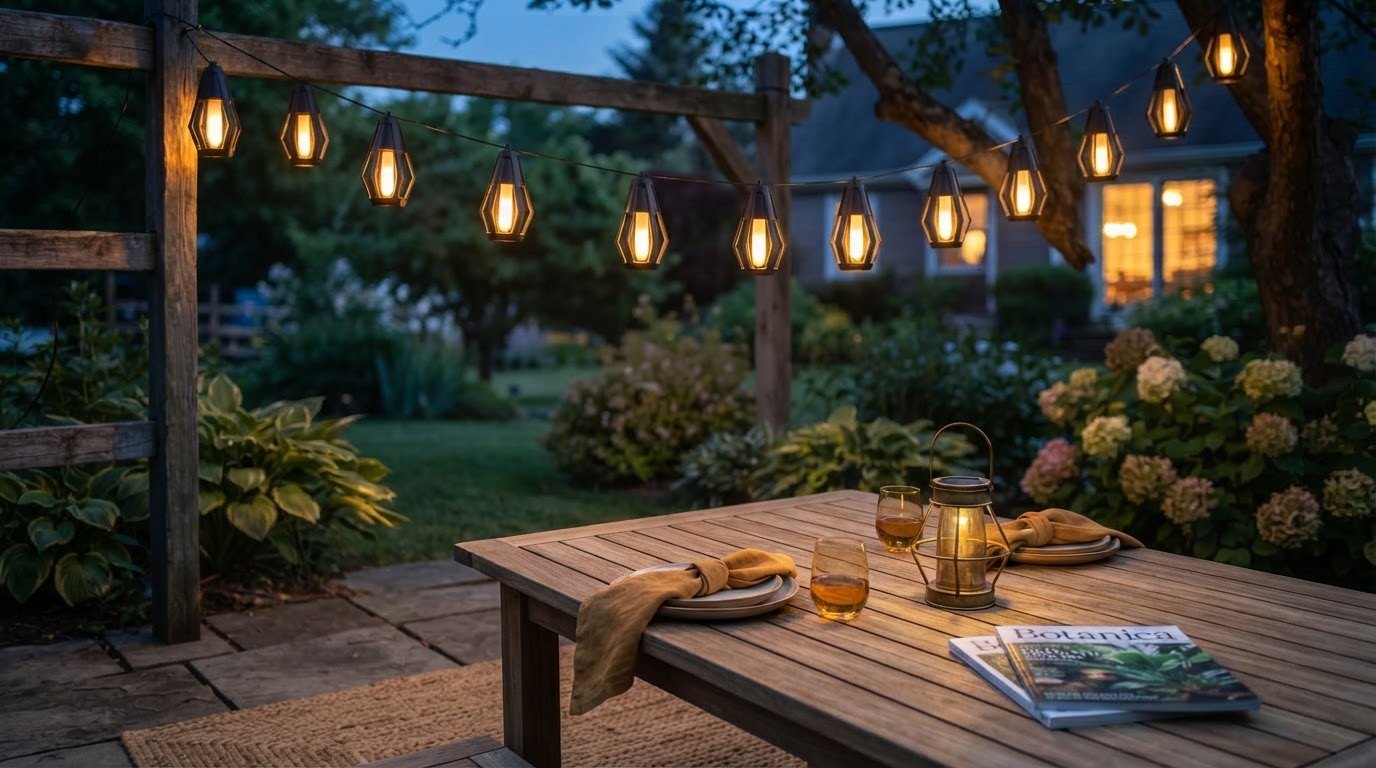
Enhancing Backyard Ambiance with SolarFlame String Lights
 Jordan HaleStaff Writer
September 6, 2026. This exploration details the transition from harsh floodlights to the soft, rhythmic glow of solar-powered flickering LEDs. It is written for homeowners seeking to balance aesthetic warmth with sustainable energy solutions.
I remember sitting on my deck last July, squinting under a high-wattage security light that made my garden look like a parking lot. The crickets were loud, but the atmosphere was sterile. I wanted something that mimicked the primitive, soothing pull of a campfire without the smoke or the permanent installation of gas lines. The challenge with traditional outdoor lighting often lies in the infrastructure; running electrical conduits through a manicured lawn is a logistical headache that many of us simply avoid. According to the International Dark-Sky Association, the quality of outdoor lighting significantly impacts both human well-being and local ecosystems, suggesting that warmer, shielded light sources are preferable to blue-rich, unshielded white lights. This shift toward intentional lighting is where the concept of patio ambiance flame lighting becomes essential. We often think of lighting as a utility—a way to see the path—but in a backyard, it functions more like furniture. It defines the boundaries of the room. When the sun dips below the horizon, the transition should feel natural rather than jarring. The first thing I noticed was how much the physical environment changed when the light temperature dropped. High-intensity bulbs tend to flatten textures, making stone walls and wooden pergolas look two-dimensional. By contrast, a flickering source adds depth through movement. It turns out that the human eye is naturally drawn to the cadence of a flame, a biological leftover from thousands of years of hearth-side living. Creating that outdoor flickering flame lights effect requires a specific type of technology that doesn't just blink on and off but simulates the organic randomness of a burning wick.
Photo by Tom Fisk on Pexels
SolarFlame String Lights address these environmental and aesthetic challenges by decoupling the light source from the power grid. These aren't the standard dim plastic stakes found in hardware store bins; they are designed to capture solar energy during the day to power a sophisticated internal LED controller that mimics a 1,800K color temperature—the sweet spot for fire-like warmth. Somewhere around week two of using these, I realized I had stopped thinking about the "solar" aspect entirely. The heavy-duty casing and weather-resistant wiring meant they survived a late-summer thunderstorm without a flicker of hesitation. The integration of solar flame string lights into a landscape allows for creative placement that wired systems can't match. I draped mine through an old oak tree, a feat that would have required an electrician and hundreds of dollars in labor if I were using traditional 120V strands. The internal battery capacity is calibrated to provide a consistent discharge, ensuring the flame effect remains fluid rather than stuttering as the charge wanes. This consistency is vital for maintaining solar patio lights with flame effect throughout the evening hours. I keep coming back to the weight of the bulbs; they feel substantial in the hand, suggesting a build quality that handles the expansion and contraction of outdoor temperature swings. Because they rely on high-efficiency monocrystalline solar panels, they charge even on those hazy, overcast afternoons when the sky looks like a gray wool blanket. This reliability ensures that the transition to outdoor flickering flame lights happens automatically at dusk, requiring zero manual intervention from the homeowner.
Deciding how to map out your backyard lighting requires a framework that considers both the architecture of your home and the natural flow of your garden. You aren't just hanging lights; you are directing the movement of your guests' eyes. Start by identifying the "anchor points"—the sturdy structures like fences, trees, or porch eaves that can support the tension of a long run of bulbs. It is important to avoid over-lighting; the goal is a soft glow that invites conversation, not a spotlight that demands attention. When evaluating your space for SolarFlame String Lights, consider the following checklist to ensure the best results:
- Solar Exposure: Ensure the primary charging panel receives at least 6 hours of direct sunlight, ideally positioned facing south to maximize energy harvest.
- Drape and Tension: Calculate the distance between your anchor points, adding 10% to the total length to allow for a natural, elegant swag rather than a tight, clinical line.
- Color Temperature Sync: Match your flame-effect lights with other warm-toned accents to avoid a visual clash with cool-toned security or path lights.
- Vertical Layering: Place string lights at varying heights—some along a fence line and others overhead—to create a three-dimensional field of light.
- Automated Cycles: Verify that the built-in dusk-to-dawn sensors are not obscured by eaves or thick foliage, which could trigger the lights prematurely.
Shop SolarFlame String Lights here.